

Key Takeaways
- Choosing the right kW capacity for your EV charging station depends on vehicle types and expected charging times.
- Assess site load to ensure enough electrical capacity for the planned number of EV chargers.
- A combination of AC and DC chargers can optimize charging efficiency for varied vehicle needs.
- Shree Narayan Engineering Pvt. Ltd. offers scalable solutions tailored to future EV charging demands.
- Evaluate specific site factors to determine the best charger mix for your EV charging station setup in India.
Shree Narayan Engineering Pvt. Ltd. is a leading manufacturer of EV charging station solutions for commercial, public and fleet applications. One of the first questions we hear from buyers is, “What kW charger should we install?” The answer depends on much more than the charger rating.
As an EV charging station manufacturer in India, we evaluate the vehicle type, typical parking time, available electrical capacity, and expected number of vehicles charging simultaneously to identify the most appropriate charging setup.
Start With the Vehicles, Not the Charger
A residential society’s charging station serves a very different purpose than one designed for a highway, bus depot, or commercial fleet.
That difference matters because charging speed is only useful when it matches the vehicles and the way they use the site. A location where cars remain parked for several hours may not need the same charger mix as a highway stop where drivers expect shorter charging sessions.
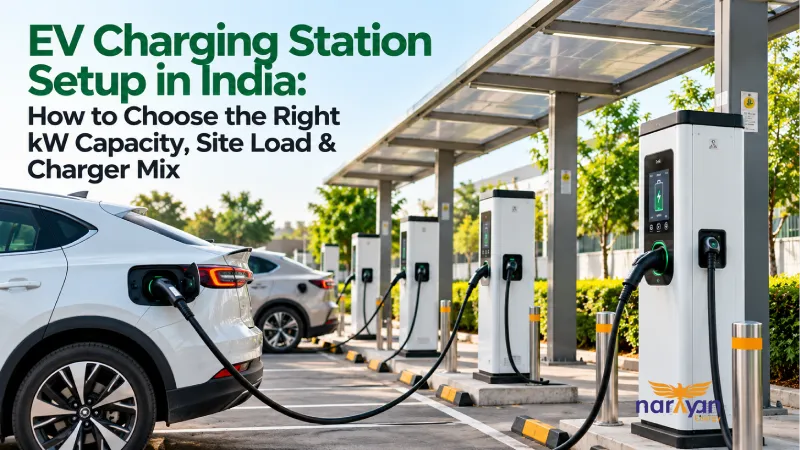
Our EV charging solutions cover AC Type-2 and DC fast charging, with customizable power ratings from 3.3 kW to 240 kW.
How Should You Choose the Charger kW Capacity?
Higher kW does not automatically mean a better charging station.
For many projects, the better question is how quickly vehicles actually need to leave the site. Lower-power AC charging is suitable for locations where vehicles are parked for longer periods. DC fast charging is more relevant when shorter turnaround is important.
Here is a practical way to look at the options:
| Site Type | Typical Charging Need | Charger Approach |
|---|---|---|
| Residential societies | Longer parking periods | Mainly AC charging |
| Offices and commercial complexes | Several hours of parking | AC with selected faster options |
| Malls and retail locations | Mixed parking duration | Combination of AC and DC |
| Highway charging hubs | Faster vehicle turnaround | Greater DC fast-charging presence |
| Fleet depots | Planned vehicle schedules | Mix based on fleet duty cycle |
| Bus depots | Higher-energy vehicle charging | Higher-capacity charging planning |
At Shree Narayan Engineering Pvt. Ltd., we do not approach the station as a collection of chargers. The charger rating, quantity and layout need to work together as one electrical system.
Site Load Can Decide the Entire Project
This is where many EV charging discussions become practical very quickly.
You may want several high-power DC chargers, but the site still needs enough electrical capacity to operate them. The existing building or facility demand should be considered before allocating the remaining capacity to EV charging.
As an EV Charging Station Manufacturer, we start with a site survey that reviews the location, power availability and expected charging demand. The electrical supply, panels and protection can then be planned around the station requirement.
The charger nameplate tells you what one unit can draw; site planning tells you how many units can operate together.
That distinction becomes especially important at larger commercial and fleet sites.
Why Simultaneous Charging Matters
Suppose a site installs several chargers. It does not necessarily mean every charger will run at its maximum output at the same time, but that possibility cannot simply be ignored during planning.
The likely number of simultaneous charging sessions affects electrical load, distribution equipment and the overall station design.
Smart load management can help distribute available power across connected chargers. Our EV systems support OCPP-compliant smart charging, dynamic load balancing, and remote management.
As an EV charging station manufacturer in India, we find this particularly beneficial for sites that require multiple charging points while efficiently managing their available electrical capacity.
AC, DC or Both?
For many commercial stations, the best solution is not choosing between AC and DC, but using a combination of both.
AC charging can serve vehicles that will remain at the location for longer periods, while DC units can handle drivers or fleet vehicles that need a quicker turnaround.
A sensible charger mix can provide:
- AC charging for longer parking sessions
- DC fast charging for shorter stops
- Different charging options for different vehicle categories
- Better use of available site power
- More flexibility as charging demand changes
Our systems support AC Type-2 charging as well as DC fast charging with CCS2 and CHAdeMO configurations. Connectivity options include Wi-Fi, 4G and Ethernet, while payment arrangements can support app, RFID, QR and card-based methods.
Do Not Rely Solely on Today’s Demand as the Design Basis
An EV charging station may begin with a few chargers and later need more.
This is why expansion should be discussed at the layout stage. Space for additional chargers, electrical distribution and future load requirements can be easier to manage when they are considered before the first units are installed.
At Shree Narayan Engineering Pvt. Ltd., we offer scalable charging-station setups so additional charging capacity can be introduced as demand grows. The stations can also be configured around grid, solar or hybrid power sources.
As an EV Charging Station Manufacturer, we consider future use because redesigning an undersized electrical arrangement later can complicate expansion.
What Should You Check Before Finalizing the Charger Mix?
Before deciding how many AC and DC chargers to install, the project team should answer a few site-specific questions.
- Which vehicles will regularly use the station?
- How long will those vehicles usually remain parked?
- How many vehicles may need charging at the same time?
- What electrical capacity is actually available for EV charging?
- Is fast turnaround important at this location?
- Will additional chargers be required later?
- Does the site need app, RFID, QR or other payment functionality?
These answers give an EV Charging Station Manufacturer in India a much stronger basis for recommending charger capacity than simply choosing the highest kW rating available.
Why Choose Us
In Shree Narayan Engineering Pvt. Ltd., our services cover EV charging systems right from site assessment and design, through electrical preparation, charger installation, software interface and testing & commissioning. We offer systems from 3.3 kW up to 240 kW capacity and can accommodate AC and/or DC charging, smart management via OCPP, load balancing, remote monitoring, and digital payments. As an EV Charging Station Manufacturer, we design the charging station based on the vehicle, the power available and usage at the site.
Conclusion
It should be noted that having the best EV charger doesn’t necessarily imply choosing the most powerful unit available. In other words, the choice of the most suitable charger for each case is determined by specific charging needs of residential societies, shopping centers, highways or fleet stations. The more effective method is to select the required charger power and type in accordance with real usage of the site and also keeping its future development in mind. Consulting EV Charging Station Manufacturers in India may provide additional benefits in the process.
Planning an EV charging station for a commercial property, highway location, fleet depot, fuel station or residential project? Contact Shree Narayan Engineering Pvt. Ltd. at +91 81560 60100 or email Info@narayanengineering.in today. Share your location type, available electrical load and expected vehicle traffic with our team, and we can discuss a suitable charger capacity and AC/DC mix for your project.